


Sole Proprietorship Firm
Sole-proprietorship is the form of business, which is owned, managed and controlled by an individual. It is the oldest and simplest form of business, established with the limited resources, ability and capital.
The individual entrepreneurship is the form of business organization in the head of which stands an individual as the one who is responsible, who directs its operation, who alone runs the risk of failure.´
A sole proprietorship, also known as the sole trader or simply a proprietorship, is a type of business entity that is owned and run by one natural person and in which there is no legal distinction between the owner and the business. The owner is in direct control of all elements and is legally accountable for the finances of such business and this may include debts, loans, loss etc.
The owner receives all profits (subject to taxation specific to the business) and has unlimited responsibility for all losses and debts. Every asset of the business is owned by the proprietor and all debts of the business are the proprietor's. It is a "sole" proprietorship in contrast with partnerships (which have at least two owners).
Objectives of Sole trader business:-
The sole trader business is set up for the following objectives:
1. To create self-employment:-
Sole trader business helps people to create work for them. Instead of looking for a job outside, a person can start his own small business.
2. To utilize funds:-
A person having surplus funds may start sole proprietorship to make productive use of his funds. If the funds are small and not enough for a big business, it is better to set up a small business instead of keeping the funds idle. Sole proprietorship enables the owner to have full say and complete control over the business.
3. Independent living:-
Sole trader business provides opportunity for an independent and honourable living. The sole trader is his own master and frees to take all the decisions.
4. To serve customers:-
A sole trader comes in direct contact with his customers. Therefore, he can better understand and serve the consumers. Sole trader business can be set up nearest to consumers so that they can buy their daily necessities conveniently.
5. Equitable distribution of wealth:-
Sole trader business helps in the distribution of income and wealth among a large number of people. It avoids monopoly and concentration of wealth in a few hands.
6. Feeder to large business:-
Sole proprietorship firms are usually small in size. These units provide ancillary service to big firms.
Key Features of Proprietorship Firm:-
- One Person Required as Single Entrepreneur.
- Single Owner of the Business.
- Easy to Start and Easy to Close.
- Complete Control.
- Lower Cost of Formation and Compliance
Some important licenses you may need for starting a sole proprietorship firm in India:-
PAN CARD:-
- Permanent Account Number (PAN) is a ten-digit alphanumeric number, issued in the form of a laminated card, by the Income Tax Department. It is mandatory to quote PAN on return of income, all correspondence with any income tax authority.
- A typical PAN is AABPS1205E
- A complete overview of pan card can be seen at –http://www.incometaxindia.gov.in/pan/overview.asp
- New PAN CARD application – https://tin.tin.nsdl.com/pan/
TAN CARD:-
Tax Deduction Account Number (TAN) is an alphanumeric number issued to individuals who are required to deduct tax on payments made by them under the Indian Income Tax Act, 1961. The Tax Deducted at Source on payments made by assesses has to be deposited under the following number to enable the assesses who have received the payments to claim the tax deducted in their income tax return. So TAN is the abbreviation for Tax deduction and collection Account Number.
Application for tan card – https://tin.tin.nsdl.com/tan/
SERVICE TAX REGISTRATION:-
Service tax has to be paid to the Government of India by the service provider who collects the same form his customers. As on 1st May, 2006, 95 services are identified as taxable services in India. Section 64 of the Finance Act, 1994, extends the levy of service tax to the whole of India, except the State of Jammu & Kashmir. The current rate is 14.50 % on the gross value of the service.
Service tax can be paid online – https://www.aces.gov.in/
VAT AND CST:-
VAT (Value Added Tax) is a form of indirect tax imposed only on goods sold within a particular state, which essentially means that the buyer and the seller exist in the same state. Only when tangible goods and products are sold, VAT can be imposed. VAT (Value Added Tax) is governed by respective state Acts. Every state has a separate and distinct VAT act reserved for their state.
CST (Central Sales Tax) is a form of indirect tax imposed only on goods sold from one state to another state, which particularly takes into account that the buyer and the seller exist in two different states. CST (Central Sales Tax) is governed by Central Sales Tax Act, 1956. This tax is governed by a single central act, though the chargeability is state specific.
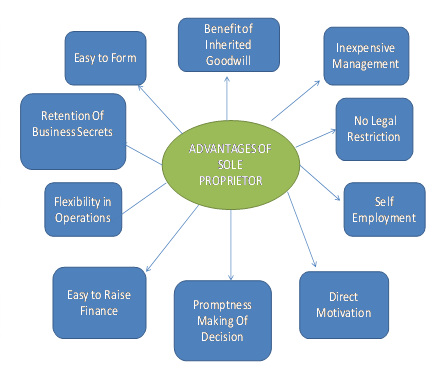
ADVANTAGES OF SOLE PROPRIETOR: -
The sole proprietorship form of business organization has certain merits. There are given below:-
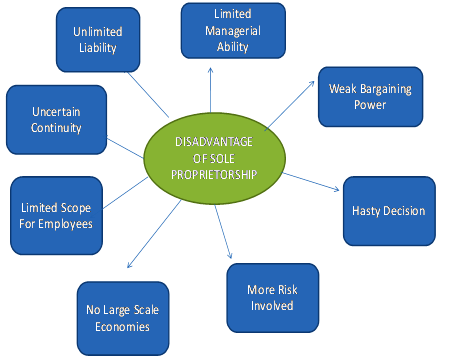
DISADVANTAGE OF SOLE PROPRIETORSHIP: -
We provide the following registration with affordable price for a sole proprietorship businessafter receiving the requisite documents:
1) Obtaining PAN card for the Individual proprietor.
2) Obtaining TAN for the Individual proprietor.
3) Service Tax registration all over India.
4) VAT/CST registration in New Delhi.
5) Opening of current bank account in the name of the sole proprietorship business.
6) Maintenance of books of account for the sole proprietorship business.
7) Filling of Income tax return, service tax return, sales tax return and TDS return if any.
*************************

No comments:
Post a Comment